

Key Takeaways
The Internal Revenue Service (IRS) has announced inflation-adjusted federal income tax brackets for 2027, with higher income thresholds across all seven tax brackets.
The standard deduction will increase to $16,600 for single filers and $33,200 for married couples filing jointly.
The SALT deduction cap will increase to $40,804 in 2027, subject to income limitations.
Every year, the Internal Revenue Service (IRS) evaluates tax provisions and adjusts them if necessary. As a result, the IRS has recently announced inflation-adjusted changes to the 2027 tax brackets among other provisions for the upcoming year.
While the seven federal income tax rates remain unchanged, ranging from 10% to 37%, the income levels associated with each bracket have increased. Similar to the 2026 tax bracket adjustments, these changes may allow taxpayers to earn more income before moving into a higher marginal tax bracket.
It is important to note that these adjustments apply to income earned in 2027 and tax returns filed in 2028.
2027 Federal Tax Brackets
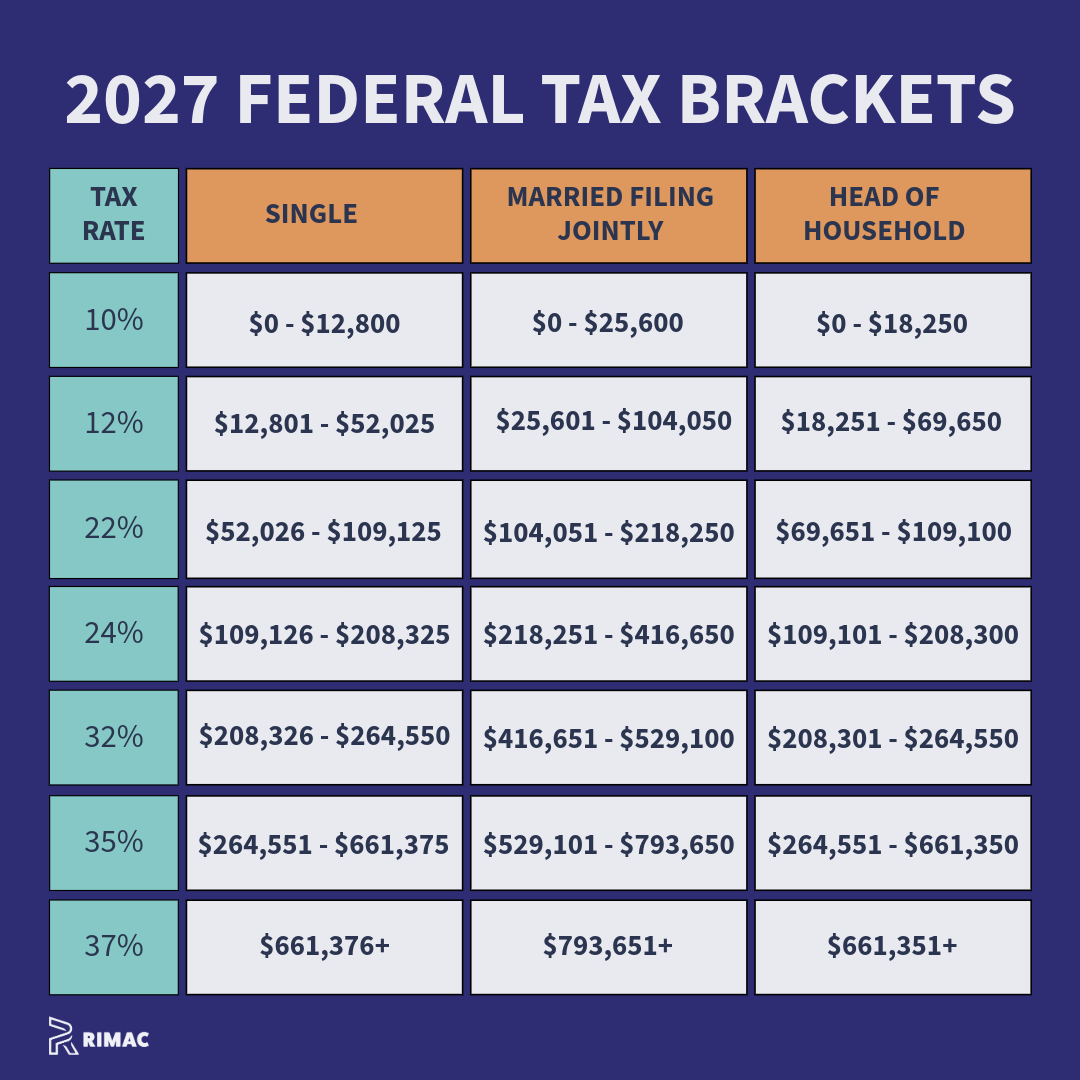
Source: Rimac Capital
What are tax brackets?
Federal tax brackets are income ranges that determine the percentage of federal income tax you owe, based on your earnings and filing status (e.g., single, married). The U.S. tax system is progressive, meaning income is taxed at increasing rates as it rises. Each portion of your income is taxed at the rate for the corresponding bracket, not the highest rate throughout.
For example, in 2027, a single taxpayer's first $12,800 of taxable income falls within the 10% tax bracket. Income above that amount, up to $52,025, falls within the 12% bracket. Any additional taxable income is subject to the corresponding higher brackets.
What's Changing in the 2027 Tax Brackets?
For 2027, the tax brackets range from 10% to 37%. These rates are the same as 2026, but the difference is the taxable income range for each rate.
For single filers, if your taxable income is over $208,325, or $416,650 as a joint filer, your 2027 marginal rate is at least 32%. In 2026, the income level for the 32% marginal tax rate was anything above $201,775 for single filers and $403,550 for married couples filing jointly.
Here is a summary of all tax bracket changes for 2027:
10% for taxable income up to $12,800 ($25,600 for married couples filing jointly). 2026 income threshold: $12,400 single/$24,800 married filing jointly.
12% for taxable income over $12,800 ($25,600 for married couples filing jointly). 2026 threshold: $12,400 single/$24,800 married filing jointly.
22% for taxable income over $52,025 ($104,050 for married couples filing jointly). 2026 threshold: $50,400 single/$100,800 married filing jointly.
24% for taxable income over $109,125 ($218,250 for married couples filing jointly). 2026 threshold: $105,700 single/$211,400 married filing jointly.
32% for taxable income over $208,325 ($416,650 for married couples filing jointly). 2026 threshold: $201,775 single/$403,550 married filing jointly.
35% for taxable income over $264,550 ($529,100 for married couples filing jointly). 2026 threshold: $256,225 single/$512,450 married filing jointly.
37% for taxable income over $661,375 ($793,650 for married couples filing jointly). 2026 threshold: $640,600 single/$768,700 married filing jointly.
New Standard Deduction Changes for 2027
The standard deduction is a fixed dollar amount that helps lower an individual’s taxable income. This amount varies depending on your filing status. You have two choices when you file your taxes:
Standard deduction: In this scenario, you deduct the standard deduction amount from your adjusted gross income for the year. The outcome, assuming no other deductions, is your taxable income, which is what your tax is based on.
Itemized deductions: Here the taxpayer can itemize deductible expenses such as mortgage interest, medical expenses, charitable donations and more. If these expenses add up to more than the standard deduction, the taxpayer could use this option.
Standard deduction amounts for 2027:
$16,600 for single filers and married individuals filing separately, a 3.11% increase from 2026's $16,100 ($500 increase).
$33,200 for married couples filing jointly, compared to $32,200 in 2026 ($1,000 increase).
$24,925 for heads of household, increasing $775 from the tax year 2026.
To conclude our understanding of the standard deduction, as an example, a single filer earning $100,000 of income for the year could apply the 2027 standard deduction to reduce their taxable income to $83,400. Similarly, a married couple filing jointly with a combined income of $300,000 could reduce their taxable income to $266,800. These examples assume no other income adjustments or deductions.
Other Tax Provision Changes
HSAs and FSAs: Starting in 2027, taxpayers who contribute to a health flexible spending account (FSA) can contribute up to $3,500 and, if their plan permits, carry over up to $700 into the next tax year. For those with health savings accounts (HSA), the 2027 limit for contributions will rise to $4,500 for self-only coverage and $9,000 for family coverage.
Estate tax: This is the dollar figure for how much in assets can be sheltered from the federal estate tax. The federal estate-tax exclusion amount will increase to $15.48 million, up from $15 million in 2026.
Tax-free gifts: For 2027, the annual exclusion for gifts will increase to $20,000 per recipient, compared to $19,000 in 2026. Contributions to a 529 college savings plan generally qualify for this exclusion. Additionally, individuals can elect to contribute up to $100,000 ($200,000 for married couples) to a 529 plan in a single year without using their lifetime gift tax exemption, provided they elect to spread the contribution over five years and meet the applicable requirements.
Earned Income Tax Credit (EITC): The EITC helps low- to moderate-income workers and families get a tax break. For 2027, the maximum EITC amount that a qualifying family with three or more children can claim will increase to $8,496, up from $8,231 in 2026. The actual credit depends on income, filing status, and the number of qualifying children.
Child Tax Credit: For 2027, the maximum Child Tax Credit will increase to $2,300 per qualifying child, compared to $2,200 in 2026. The maximum refundable portion will also increase to $1,800, up from $1,700 in 2026.
Tax Effects of the ‘Big, Beautiful Bill’
Alongside the IRS' annual inflation adjustments, provisions introduced under the One Big Beautiful Bill Act (OBBBA) will continue to influence taxpayers' federal income tax calculations in 2027.
Cap on itemized deductions: Taxpayers in the 37% federal income tax bracket will continue to face a limitation on the tax benefit of itemized deductions. Generally, the maximum federal tax benefit of affected deductions is limited to 35 cents per dollar rather than 37 cents.
SALT deduction increases: The state and local tax (SALT) deduction cap increased significantly in 2025, rising from $10,000 to $40,000. In 2026, the limit increased to $40,400, and for 2027, it will rise again to $40,804. However, the deduction is subject to income-based phaseouts for higher-income taxpayers, meaning not everyone will qualify for the full amount.
Connect with Us Today
Schedule a free 30-minute consultation call. We’ll learn more about your priorities and ensure we can answer all of your questions.